
Jakarta, April 16, 2026 – Efforts to protect Indonesian fishing vessel crews continue to face challenges due to the fragmentation of international legal and institutional regimes. This calls for stronger cooperation between Indonesia and relevant international organizations to develop a comprehensive protection strategy. This was the key narrative emerging from a discussion titled “Human Rights Protection at Sea and Its Relevance for Indonesian Migrant and Domestic Fishing Vessel Crews,” organized by the Indonesia Ocean Justice Initiative (IOJI). The event brought together key stakeholders from the Ministry of Foreign Affairs and the Ministry for the Protection of Indonesian Migrant Workers, international academics, and civil society to discuss developments in international law and strengthen protections for Indonesian fishing vessel crews.The event was attended by Vice Minister for the Protection of Indonesian Migrant Workers, Christina Aryani; Vice Minister of Foreign Affairs of the Republic of Indonesia and Ambassador, Arif Havas Oegroseno; Professor of International Law of the Sea at SOAS University of London, Irini Papanicolopulu; and Chief Executive Officer of IOJI, Achmad Santosa. Representatives from the Ministry for the Protection of Indonesian Migrant Workers/BP2MI, the Ministry of Foreign Affairs, and the Ministry of National Development Planning (Bappenas) were also present.
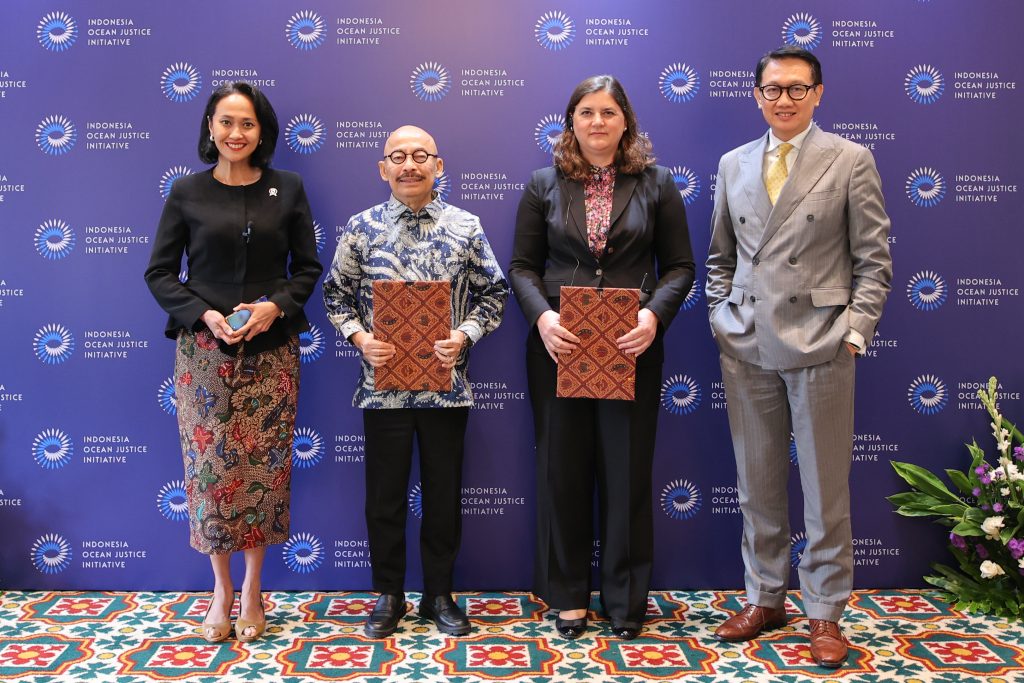
In her remarks, Vice Minister for the Protection of Indonesian Migrant Workers Christina Aryani stated that to address the layered risks faced by migrant fishing vessel crews throughout the migration cycle, the Ministry is working to accelerate regulatory reforms, digitalization, and the strengthening of data systems, enhance diplomacy to align with international standards, and improve crew competencies and certification. She also emphasized the importance of strengthening bilateral diplomacy, including with Taiwan and China, to ensure fairer standards regarding wages and working conditions for migrant fishing crews.
“In 2026, we are targeting the harmonization of licensing requirements between the Ministry for the Protection of Indonesian Migrant Workers and the Ministry of Transportation to eliminate dual licensing, as part of implementing Constitutional Court Decision No. 127/PUU-XXII/2024, Law No. 18 of 2017 on the Protection of Indonesian Migrant Workers, and Government Regulation No. 22 of 2022 on the Placement and Protection of Migrant Commercial Ship Crews and Migrant Fishing Vessel Crews,” she stated.
Vice Minister of Foreign Affairs and Ambassador Arif Havas Oegroseno highlighted structural challenges in global governance, which remains fragmented in addressing the protection of fishing vessel crews, as well as the lack of comprehensive discussions covering the entire fisheries ecosystem, from crew recruitment to fishing operations and trans-shipment at sea.
“Efforts to strengthen linkages between FAO, IMO, and ILO are essential moving forward. Indonesia must continue to lead the global discourse on protecting fishing vessel crews through a comprehensive and integrated system that provides protection from start to finish,” he stated.
According to IOJI CEO Mas Achmad Santosa, the Indonesian government has undertaken a series of regulatory strengthening measures and international cooperation initiatives to protect the rights of both migrant and domestic fishing crews, including recognizing fishing vessel crews as workers under human rights-related legislation.
“The fundamental issues lie in overlapping placement licensing systems that complicate monitoring and law enforcement, limited labor oversight at sea for Indonesian-flagged vessels and abroad for foreign-flagged vessels, and the difficulty in ensuring access to justice for victims,” he said.
Indonesia is currently facing structural challenges, including discriminatory practices against migrant fishing vessel crews across jurisdictions and the widespread use of flags of convenience, which weakens the accountability of flag states in ensuring the protection and recovery of fishing crews’ rights. These conditions are further exacerbated by jurisdictional complexities at sea and fragmentation between human rights and law of the sea regimes, ultimately limiting access to justice and legal protection for fishing vessel crews.
Addressing these challenges, the discussion emphasized the importance of integrating human rights protection into sustainable ocean governance. In this context, Irini Papanicolopulu stated, “It is not possible to achieve the sustainable use of the ocean and its resources if we ignore the people at sea and their rights.” She also noted that Indonesia has played a significant role in the development of the law of the sea and continues to demonstrate leadership in advancing the protection of fishing crews and human rights at sea.
In line with this, IOJI Senior Program Manager Jeremia Humolong Prasetya stated, “The solution to the structural challenges faced by Indonesia and the global community in protecting migrant fishing vessel crews lies in cooperation o at multiple levels, starting from the local, national, bilateral, regional and international levels.” He also emphasized the importance of a national coordination mechanism involving the government, associations, and civil society, including think tanks and labor unions, to jointly formulate and implement this agenda.
This discussion forum served as a constructive dialogue platform to strengthen stakeholder synergy and generate concrete steps in response to two key realities: first, Indonesia is the world’s second-largest capture fisheries producer, contributing 8% of total global catch (FAO SoFIA 2024). Second, Indonesia is a major country of origin for millions of fishing vessel crews, both on Indonesian-flagged and foreign-flagged vessels. In 2015, the Ministry of Foreign Affairs recorded 250,000 Indonesian migrant fishing vessel crew members working worldwide. Meanwhile, the Ministry of Marine Affairs and Fisheries recorded 3,228,209 fishers working across Indonesia in 2024.
Contact:Communications Manager IOJI, Waraney Rawung, [email protected]